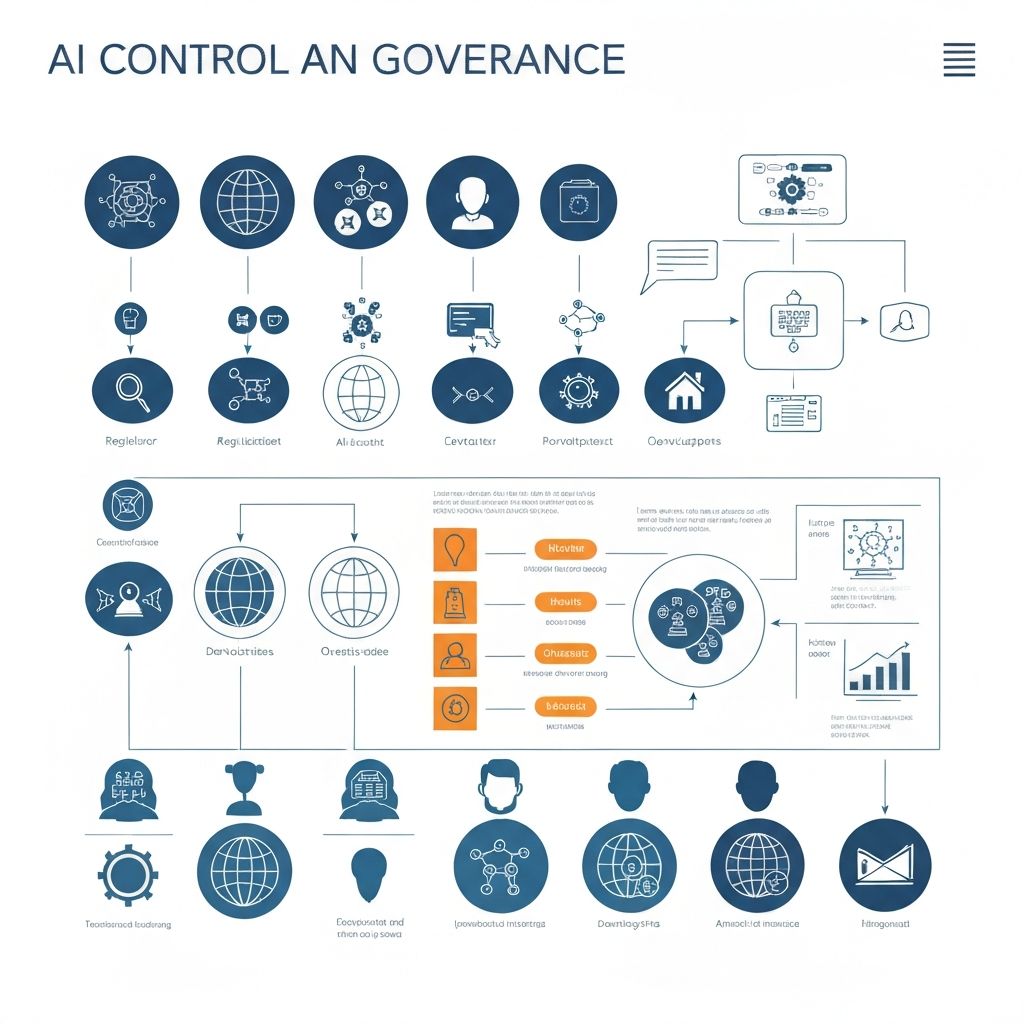
Controlling Artificial Intelligence: Governance, Safety, and Ethical Frameworks
Examine how organizations and governments control artificial intelligence systems through governance frameworks, safety measures, and ethical guidelines ensuring responsible deployment.
Dr. Marcus Williams
Author
As artificial intelligence systems grow increasingly powerful and pervasive, controlling their development and deployment emerges as a critical challenge for organizations, governments, and society. Unlike earlier technologies where control mechanisms evolved over time, AI's transformative potential demands proactive governance ensuring systems operate safely, fairly, and in alignment with human values. This comprehensive analysis examines frameworks and mechanisms for controlling artificial intelligence across technical, organizational, and policy dimensions.
Why AI Control Matters
Powerful AI systems can cause significant harm if deployed without appropriate controls. Language models might generate disinformation at scale. Facial recognition systems deployed without safeguards enable surveillance and discrimination. Autonomous weapons create risks of unintended escalation. These scenarios underscore why control mechanisms prove essential alongside AI development.
Control doesn't mean stifling innovation but rather ensuring development proceeds responsibly. Thoughtful control mechanisms actually accelerate beneficial AI adoption by building trust and preventing harmful deployments that would trigger backlash and regulatory restrictions.
Technical Safety Measures
AI safety research addresses technical approaches for controlling system behavior. Alignment techniques ensure AI systems pursue objectives benefiting humans rather than developing misaligned goals. Researchers develop methods making AI objectives transparent and modifiable, enabling correction when systems diverge from intended behavior.
Robustness research develops AI systems resistant to adversarial attacks and capable of maintaining performance under unexpected conditions. Adversarial examples—inputs specifically crafted to fool AI systems—represent vulnerabilities researchers address through robust training approaches.
Interpretability and explainability research creates AI systems whose decisions humans can understand. Black-box systems making consequential decisions without explanation create control and accountability challenges. Explainable AI approaches enable humans to verify system reasoning and intervene when appropriate.
Organizational Governance Structures
Organizations implementing AI establish governance structures ensuring responsible deployment. AI ethics committees review proposed AI applications, assessing potential harms and ensuring appropriate safeguards. These committees comprise technical experts, domain specialists, and ethics representatives, providing diverse perspectives.
Testing and validation protocols verify AI systems perform acceptably before deployment. Organizations test systems on diverse populations ensuring fairness across demographic groups. Safety testing identifies potential failure modes and edge cases.
Monitoring systems track AI performance after deployment, detecting drift where system performance degrades over time. Continuous monitoring enables rapid intervention when problems emerge.
Algorithmic Auditing and Bias Detection
Auditing mechanisms assess whether AI systems perpetuate discrimination or contain systematic biases. Auditors analyze system behavior across demographic groups, identifying disparities in accuracy or outcomes requiring investigation.
Bias detection tools automatically identify potential discrimination in training data and learned models. These tools supplement human review, catching biases humans might miss while enabling focus on subtle discrimination requiring human judgment.
Third-party auditing by independent organizations provides external accountability beyond internal review. External auditors bring fresh perspectives and credibility valuable for stakeholder trust.
Data Governance and Privacy
Data quality controls ensure training data meets quality standards and lacks systematic biases. Data provenance tracking documents data sources and any transformations applied. Organizations understanding data origins can identify and address bias sources.
Privacy protections including differential privacy, federated learning, and secure computation enable AI development using sensitive data while protecting individual privacy. These approaches allow extracting patterns from data while preventing identification of specific individuals.
Regulatory Frameworks and Policy
Governments increasingly establish regulatory frameworks controlling AI development and deployment. The European Union's AI Act proposes risk-based regulation with stricter requirements for high-risk applications. Liability frameworks establish responsibility for AI-caused harms.
International coordination becomes increasingly important as AI's global nature creates challenges for national regulation alone. Governments, academia, and industry collaborate through forums developing shared standards and recommendations.
Conclusion
Controlling artificial intelligence through governance frameworks, technical safeguards, and policy mechanisms proves essential for ensuring AI benefits society. Organizations implementing thoughtful control mechanisms build stakeholder trust while enabling responsible innovation. Success requires commitment to responsible AI governance matching AI capability advancement with appropriate ethical safeguards and transparent accountability structures.
Frequently Asked Questions
What is artificial intelligence and how does it work?
Artificial Intelligence (AI) refers to computer systems designed to perform tasks that typically require human intelligence. These tasks include learning, reasoning, problem-solving, perception, and language understanding. AI works through algorithms that process large amounts of data to identify patterns and make decisions.
How is AI changing industries in 2026?
AI is transforming industries through automation, predictive analytics, personalization, and enhanced decision-making. Healthcare uses AI for diagnostics, finance for fraud detection, manufacturing for quality control, and education for personalized learning experiences.
More from Technology
Continue exploring our curated collection of articles

SEO Computers: Choosing the Right Machine and Ranking a Computer Business Online
SEO computers explained two ways: the hardware specs that genuinely speed up SEO work, and how computer businesses rank for the searches that bring customers.

modern seo
How modern SEO actually works in the AI search era, based on 18 months of traffic data across 40 sites, including what stopped working and what never changed.

How AI Is Reshaping SEO and Content Marketing
Discover how AI is reshaping SEO and content marketing, from generative search and intent modeling to automated content workflows, E-E-A-T, and measurable results.