What Is Service Layer in Web Application: Role, Benefits, and Best Practices
Understand what is service layer in web application architecture, its core role, benefits, common patterns, and best practices for clean code design.
Hannah Greene
Author
Modern web applications can become tangled very quickly. As teams grow and features pile up, business logic often spreads across controllers, components, and database queries, making the codebase fragile and hard to change. The service layer is a well-established architectural pattern that helps solve this problem. Understanding what the service layer is, why it exists, and how to design it well can dramatically improve the maintainability, testability, and clarity of any non-trivial web application.
Defining the Service Layer
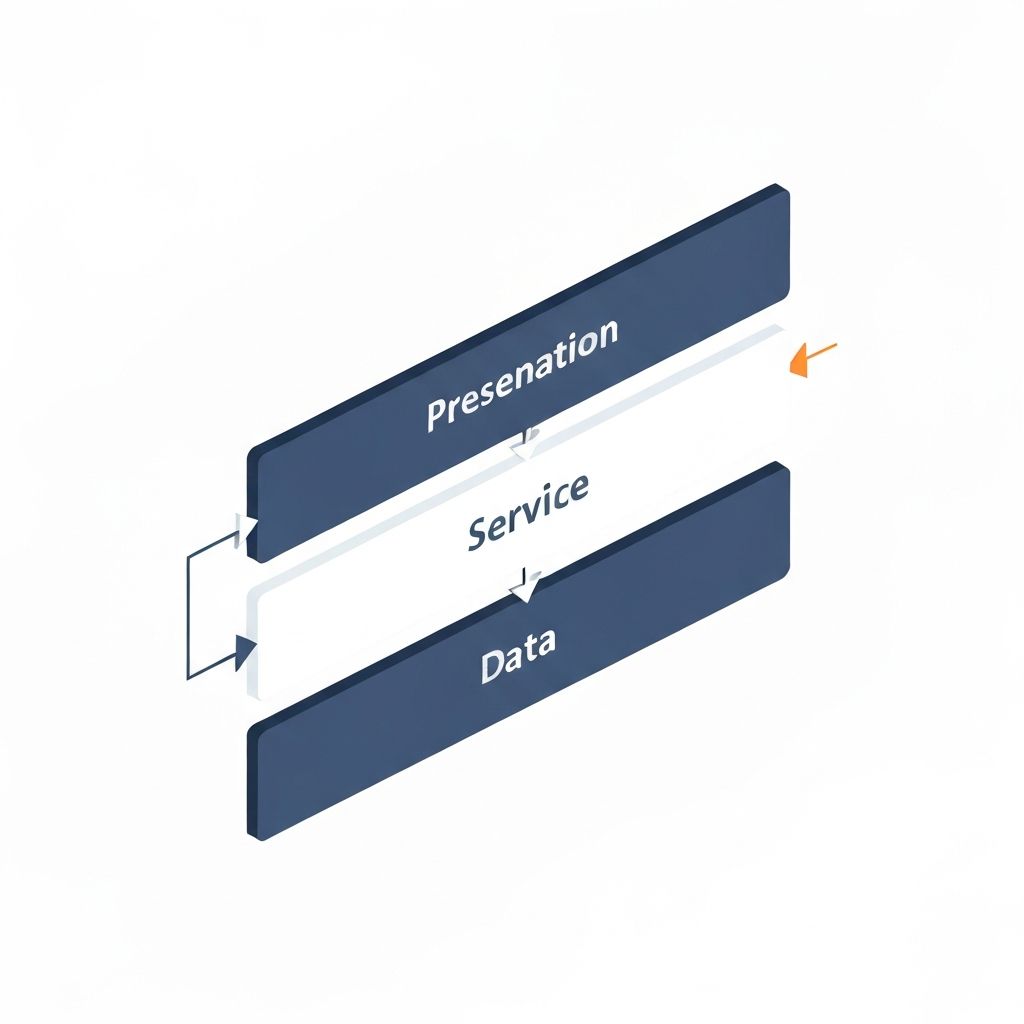
The service layer is a logical layer in a web application's architecture that encapsulates business logic and orchestrates operations between the presentation layer (controllers, components, or API endpoints) and the data access layer (repositories, ORMs, or external services). It provides a clean, application-specific API that the rest of the system uses to perform meaningful actions, such as "place an order," "register a user," or "approve a loan."
Where controllers translate HTTP requests into application calls and repositories handle persistence, services live in the middle, focusing on what the application does rather than how it talks to the network or the database.
Why Web Applications Need a Service Layer
Without a service layer, business logic tends to drift into whichever layer is most convenient at the time. Controllers become bloated with validation, calculation, and database calls. Front-end components query data directly and replicate business rules. Tests become harder to write because logic is intertwined with frameworks, transports, and databases.
The service layer corrects these problems by providing one canonical place for business operations. This separation pays off in several ways. It improves testability because services can be unit-tested without spinning up HTTP servers or real databases. It reduces duplication by ensuring that a given business rule is implemented in exactly one place. And it allows the same logic to be reused across different entry points — a REST API, a GraphQL endpoint, a background worker, or a CLI tool — without rewriting it.
Responsibilities of a Well-Designed Service Layer
A clean service layer typically takes on several responsibilities. It encodes business rules and constraints, such as "an order cannot be shipped before it is paid" or "a user cannot have more than three active sessions." It orchestrates multiple data sources, combining results from databases, caches, and external APIs into coherent operations. It enforces transactions, ensuring that multi-step changes either complete fully or roll back together. And it returns meaningful results or domain-specific errors, rather than raw database exceptions.
Crucially, services should not depend on details of the presentation layer. They should not know about HTTP status codes, request headers, or rendering. By keeping these concerns out, the service layer remains usable in many contexts.
Common Patterns
There are several patterns that shape how a service layer is typically organized. The application service pattern, often associated with domain-driven design, groups operations by use case. For example, an OrderService might expose methods like placeOrder, cancelOrder, and refundOrder, each representing a distinct business action.
In larger systems, a thinner application service may delegate to a richer domain model, where entities like Order, Customer, and Invoice carry behavior of their own. In simpler systems, a "transaction script" style can be used, where each service method directly performs the steps required for a use case without a deep object model.
Layered architecture, hexagonal architecture (ports and adapters), and clean architecture all give the service layer a central role. While the specifics differ, the underlying idea is the same: insulate business logic from frameworks and infrastructure so that the application can evolve independently.
Service Layer in Different Stacks
The implementation details vary across technologies. In Node.js applications, services are usually plain modules or classes that controllers import and call. In .NET, services are commonly registered with dependency injection and consumed by controllers in ASP.NET Core. In Spring Boot, services are annotated with @Service and integrate naturally with Spring's transaction and security infrastructure. In Python, frameworks like Django or FastAPI may not have a built-in concept of a service layer, but teams often introduce one explicitly to keep views and routers focused on transport.
In all cases, the pattern is similar: a layer that consumes repositories and other services, exposes methods to higher layers, and contains the rules that make the application unique.
Practical Example
Consider a checkout feature. A controller receives the HTTP request and validates the input format. It then calls OrderService.placeOrder, passing the validated data. The service checks inventory through ProductRepository, calculates totals using PricingService, validates the customer with CustomerService, creates an Order through OrderRepository, and triggers a payment via PaymentGateway. If anything fails, the service rolls back changes and returns a domain-specific error.
The controller never deals with inventory rules, pricing logic, or payment retries. The repositories never decide whether an order is valid. Each layer has one clear responsibility, which makes the system easier to reason about and to evolve.
Best Practices
Several practices help service layers stay healthy as a system grows. Keep services focused around business use cases rather than database tables; a service whose methods read like CRUD on a single table is usually a sign that the abstraction is too thin. Prefer constructor injection or explicit dependency wiring so that services can be tested in isolation. Avoid hidden state — services should be stateless where possible, with all relevant context passed in as parameters.
Use domain-specific types and exceptions instead of leaking infrastructure concerns. Methods should return rich result types or throw business-meaningful errors, allowing callers to handle outcomes intelligently. Where appropriate, encapsulate transaction boundaries inside the service rather than asking controllers to manage them.
Finally, resist the urge to create services for every concept. A service layer is most valuable when it represents real business operations. Wrapping a single line of code in a service simply for the sake of consistency can make the system harder, not easier, to understand.
Common Pitfalls
A few anti-patterns appear repeatedly. "Anemic services" that simply pass calls through to repositories add ceremony without value. "God services" that handle dozens of unrelated operations quickly become unmanageable. Services tightly coupled to specific frameworks — accepting HTTP request objects, for example — lose much of their reusability. And services that mix business logic with cross-cutting concerns like logging, caching, and authorization can be cleaned up by extracting these concerns into middleware, decorators, or aspects.
The Service Layer in Modern Architectures
In microservices and serverless architectures, service layers still exist but live within individual services or functions. A single microservice may have its own internal service layer separating handlers from domain logic. Even in event-driven systems, services often consume events and produce new ones while encapsulating business rules in the same way they do in synchronous APIs.
This consistency is part of what makes the pattern so durable. Whether an application is a monolith, a set of microservices, or a serverless mesh, having a clear place for business logic remains essential.
Conclusion
The service layer in a web application is the home of business logic and the boundary between transport and persistence. By giving each use case a clear, testable, and reusable representation, it brings order to systems that would otherwise collapse under their own complexity. For any team building or maintaining a non-trivial web application, investing in a well-designed service layer is one of the most reliable ways to keep code clean, change cheap, and quality high over the long term.
More from Technology
Continue exploring our curated collection of articles

SEO Computers: Choosing the Right Machine and Ranking a Computer Business Online
SEO computers explained two ways: the hardware specs that genuinely speed up SEO work, and how computer businesses rank for the searches that bring customers.

modern seo
How modern SEO actually works in the AI search era, based on 18 months of traffic data across 40 sites, including what stopped working and what never changed.

How AI Is Reshaping SEO and Content Marketing
Discover how AI is reshaping SEO and content marketing, from generative search and intent modeling to automated content workflows, E-E-A-T, and measurable results.