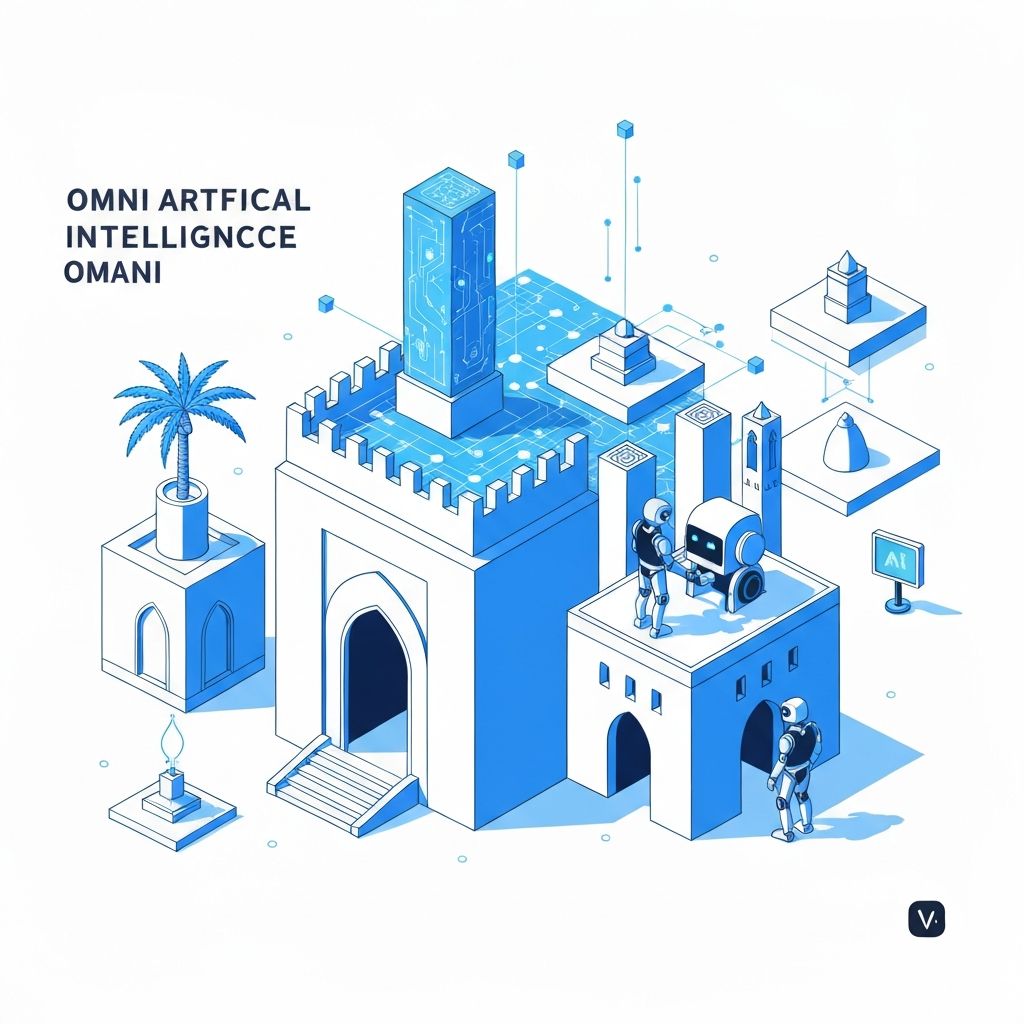
Oman's Artificial Intelligence Revolution: Driving Digital Transformation in the Middle East
Explore how Oman is leveraging artificial intelligence technology to drive economic diversification, enhance government services, and position itself as a regional AI innovation hub.
Dr. Hassan Al-Mansouri
Author
Oman stands at a pivotal moment in its digital transformation journey, with artificial intelligence emerging as a cornerstone technology reshaping the sultanate's economic landscape and societal development. As a nation traditionally dependent on oil revenues, Oman recognizes that sustainable prosperity requires strategic investments in transformative technologies. Artificial intelligence represents not merely a technological upgrade but a fundamental restructuring of how government, business, and society operate. This comprehensive analysis examines Oman's AI revolution, its strategic initiatives, implementation challenges, and the profound implications for the region's future.
Strategic Context: Why Oman Embraced AI
Oman's AI adoption strategy emerges from careful analysis of global economic trends and the sultanate's unique position. With world oil prices volatile and reserves finite, Oman cannot sustain its economy on hydrocarbons alone. The government recognized that nations leveraging AI effectively would capture disproportionate economic growth and competitive advantages in emerging industries. Vision 2040, Oman's long-term development strategy, explicitly identifies digital transformation and AI as critical pillars supporting economic diversification.
The sultanate's government embraced AI not as a peripheral technology but as fundamental to achieving strategic objectives. This commitment manifests through substantial investments in AI research, development of regulatory frameworks, education initiatives, and direct deployment across government services. Unlike nations adopting AI reactively, Oman approached the technology strategically, aligning AI initiatives with broader development goals.
Government AI Initiatives and Smart Governance
Oman's government has pioneered innovative applications of AI in public administration and citizen services. The implementation of AI-powered customer service systems across government departments revolutionized citizen interactions. Citizens increasingly resolve administrative matters through intelligent chatbots and automated systems rather than waiting in physical queues, dramatically improving service delivery while reducing administrative burdens.
The Ministry of Commerce and Industry established the AI Center of Excellence, serving as a hub for government AI projects, research collaboration, and private sector engagement. This center coordinates AI initiatives across ministries, ensuring consistent standards, preventing duplicative efforts, and facilitating knowledge sharing among government agencies. The center also engages international AI experts, bringing global best practices and cutting-edge knowledge into Oman's government operations.
Oman's tax and customs systems increasingly employ machine learning algorithms for fraud detection, risk assessment, and compliance monitoring. These systems analyze patterns across thousands of transactions in seconds, identifying suspicious activities that human reviewers might miss. The technology simultaneously improves revenue collection and compliance outcomes while reducing processing delays for legitimate transactions.
Healthcare represents another area where Oman deployed AI strategically. Hospitals utilize AI diagnostic systems supporting radiologists in detecting diseases like cancer and COVID-19 from medical imaging. These systems don't replace medical professionals but rather augment their capabilities, enabling faster, more accurate diagnoses while reducing diagnostic workload on healthcare providers.
Private Sector AI Development
Beyond government initiatives, Oman's private sector embraced AI adoption across diverse industries. Financial institutions implemented AI-powered fraud detection, algorithmic trading, and personalized customer recommendations. Banks and fintech companies recognized AI's potential for identifying financial crimes, assessing credit risk, and providing customized financial products based on customer behavior and preferences.
Telecommunications companies deployed AI for network optimization, customer service automation, and predictive maintenance. These applications improved service quality while reducing operational costs, making telecommunications services more affordable for ordinary Omanis. Customer service AI systems handle routine inquiries instantly while directing complex issues to human agents, creating hybrid support systems that balance automation with human judgment.
The oil and gas sector, despite its traditional nature, embraced AI for predictive maintenance, reservoir optimization, and production efficiency. AI systems analyze equipment sensor data to predict failures before they occur, preventing costly downtime and safety incidents. In exploration operations, machine learning algorithms analyze geological data to identify promising drilling locations, improving exploration efficiency.
Retail and e-commerce companies deployed recommendation engines and demand forecasting systems. These technologies personalize shopping experiences and optimize inventory management, reducing stockouts and overstock situations while improving profitability.
Education and Workforce Development
Recognizing that AI adoption requires technically skilled populations, Oman invested substantially in AI education and workforce development. Universities incorporated AI and machine learning into computer science curricula, ensuring graduates possess contemporary technical skills. The Sultan Qaboos University expanded computer science programs and established specialized AI research groups.
Technical institutes and vocational training centers developed AI and data science curricula accessible to secondary school graduates. These programs create pathways for talented individuals regardless of university attendance, building diverse talent pipelines. Online courses and certification programs make AI education accessible even to working professionals seeking skill enhancement.
The government established scholarships and sponsorship programs for Omani students pursuing AI education abroad, particularly in leading universities known for AI excellence. These initiatives create a cadre of internationally trained AI experts who return to Oman to lead implementation initiatives and train others.
Challenges and Strategic Responses
Oman's AI transformation journey encountered predictable challenges requiring thoughtful management. Limited availability of AI talent created competition for skilled professionals, driving salaries upward and creating acquisition difficulties for some organizations. The government responded by accelerating education initiatives and implementing retention programs.
Data privacy and security concerns emerged as Oman deployed AI systems collecting and analyzing citizen information. The government established data protection regulations aligned with international standards, creating trust in digital systems. Public education campaigns emphasized how AI improves services while respecting personal privacy.
Infrastructure limitations initially constrained AI implementation, as advanced AI applications require significant computational capacity. Investments in data centers and cloud infrastructure addressed these constraints. Partnerships with international cloud providers brought world-class infrastructure capacity to Omani organizations without requiring massive direct infrastructure investments.
Regional Impact and Leadership
Oman's AI transformation positions the sultanate as a regional leader in digital innovation. Neighboring countries increasingly look to Oman as a model for strategic AI adoption. The sultanate hosts regional AI conferences, research collaborations, and knowledge-sharing initiatives, positioning itself as the Gulf region's innovation hub.
Omani expertise increasingly shapes regional AI policy discussions and implementation standards. Government officials share lessons learned through international forums, contributing to regional best practices. Business leaders showcase successful Omani AI projects, attracting investment and talent migration.
Future Prospects and Opportunities
Looking ahead, Oman's AI journey will intensify across multiple dimensions. Autonomous systems and robotics will increasingly appear in manufacturing and logistics. Smart cities initiatives will expand, leveraging AI for traffic management, energy optimization, and environmental monitoring. Healthcare AI will advance toward personalized medicine and predictive health interventions.
The integration of AI with renewable energy technologies aligns perfectly with Oman's sustainability goals. AI optimizes solar and wind energy production, manages distribution grids efficiently, and accelerates transition toward diversified energy sources reducing oil dependency.
Conclusion
Oman's artificial intelligence revolution represents a deliberate strategic response to economic imperatives and global technological transformation. By investing in AI research, education, government deployment, and private sector adoption, Oman positions itself as a forward-thinking nation leveraging cutting-edge technology to build sustainable prosperity. The sultanate's journey offers valuable lessons for other developing nations seeking to harness AI's transformative potential while managing associated challenges thoughtfully. As AI continues reshaping global economics and society, Oman's early strategic adoption positions the nation to thrive in the AI-driven future while inspiring regional peers to embrace similar transformation pathways.
Frequently Asked Questions
What is artificial intelligence and how does it work?
Artificial Intelligence (AI) refers to computer systems designed to perform tasks that typically require human intelligence. These tasks include learning, reasoning, problem-solving, perception, and language understanding. AI works through algorithms that process large amounts of data to identify patterns and make decisions.
How is AI changing industries in 2026?
AI is transforming industries through automation, predictive analytics, personalization, and enhanced decision-making. Healthcare uses AI for diagnostics, finance for fraud detection, manufacturing for quality control, and education for personalized learning experiences.
More from Technology
Continue exploring our curated collection of articles

SEO Computers: Choosing the Right Machine and Ranking a Computer Business Online
SEO computers explained two ways: the hardware specs that genuinely speed up SEO work, and how computer businesses rank for the searches that bring customers.

modern seo
How modern SEO actually works in the AI search era, based on 18 months of traffic data across 40 sites, including what stopped working and what never changed.

How AI Is Reshaping SEO and Content Marketing
Discover how AI is reshaping SEO and content marketing, from generative search and intent modeling to automated content workflows, E-E-A-T, and measurable results.