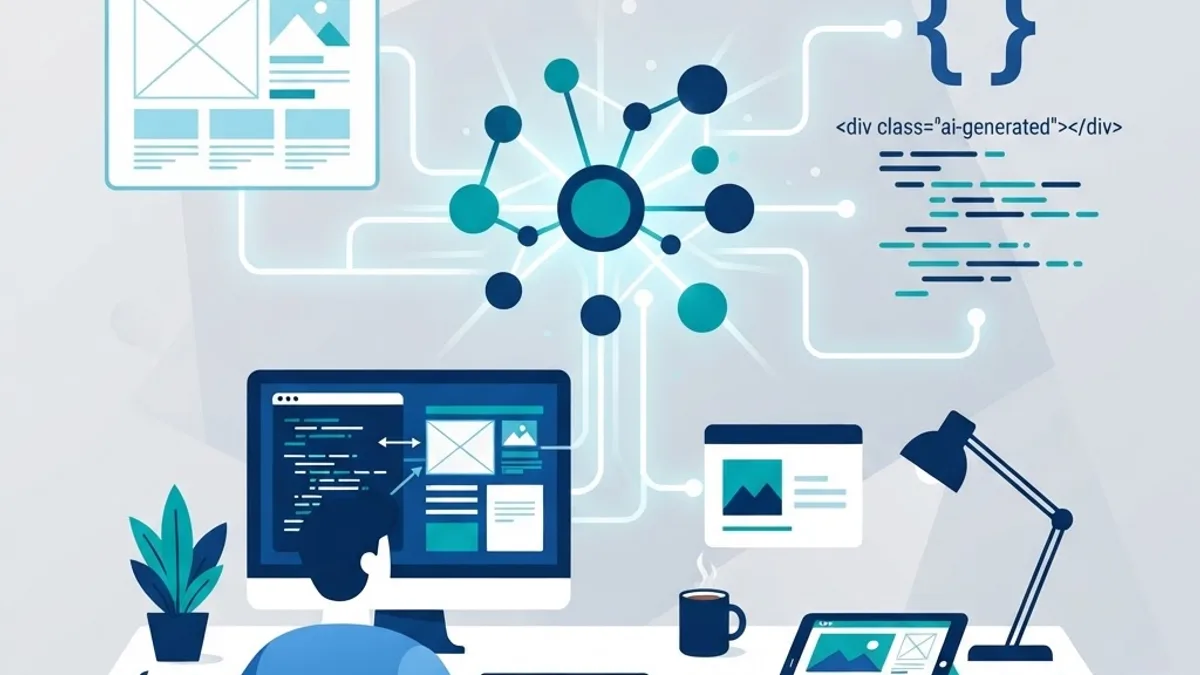
What Can Developers Do With AI Web Design?
Explore how developers use AI in web design to speed up workflows, generate code and content, personalize experiences, and build smarter, faster websites in 2026.
Marcus Feldman
Author
Artificial intelligence has moved from novelty to necessity in web design, reshaping how developers plan, build, and optimize websites. Rather than replacing skilled professionals, AI amplifies their capabilities, automating repetitive tasks, accelerating prototyping, and unlocking personalization at a scale that was impossible only a few years ago. For developers willing to learn these tools, AI web design is a genuine competitive advantage. This guide explores the practical, real-world things developers can do with AI today and how to apply them responsibly.
Accelerating Layout and Prototyping
One of the most immediate benefits of AI is speed during the earliest, most iterative phases of a project. Developers can describe a layout in plain language and receive functional starting points, complete wireframes, or component structures in seconds. Instead of spending hours arranging boxes, they can generate several directions, evaluate them, and refine the strongest option.
This rapid prototyping shortens feedback loops with clients and stakeholders. When ideas can be visualized quickly, decisions happen faster and with more confidence. The developer remains firmly in control, using AI to explore possibilities while applying human judgment about usability, brand fit, and business goals. The result is a more efficient path from concept to a polished, production-ready interface built through solid front-end web development.
Generating and Refactoring Code
AI coding assistants have become indispensable for many developers. They can scaffold components, suggest completions, translate designs into markup, write utility functions, and explain unfamiliar code. This dramatically reduces the time spent on boilerplate, freeing developers to focus on architecture, performance, and the nuanced problems that require real expertise.
AI is equally useful for refactoring and debugging. It can flag potential issues, propose cleaner implementations, and help modernize legacy code. Developers working with frameworks in React JS web development or Next JS web development can use these assistants to generate reusable components and speed up complex builds. The essential caveat is verification: AI-generated code must always be reviewed, tested, and understood before shipping, because it can produce plausible but flawed results.
Creating Content and Copy Faster
Websites live or die by their content, and AI has become a powerful drafting partner. Developers and content teams can generate first drafts of headings, product descriptions, and microcopy, then refine them for accuracy and brand voice. This is especially valuable for large sites where writing every label and description by hand would be prohibitively slow.
AI also helps with content structure, suggesting outlines, meta descriptions, and alt text. However, quality still depends on human oversight. The most effective approach pairs AI drafting with professional content writing so the final copy is accurate, original, and genuinely helpful. Search engines reward content written for people, so AI should assist the process, not replace editorial judgment.
Personalizing User Experiences
Perhaps the most transformative application of AI is personalization. By analyzing behavior, preferences, and context, AI can tailor what each visitor sees, recommending relevant products, adjusting messaging, or surfacing the most useful content. Personalized experiences increase engagement and conversions because they feel relevant rather than generic.
Developers can implement personalization through recommendation engines, dynamic content blocks, and adaptive interfaces. Building these features often requires robust back-end web development to process data securely and deliver tailored responses in real time. When done thoughtfully and transparently, personalization respects user privacy while making the experience noticeably better.
Enhancing Accessibility and Testing
AI tools can scan websites for accessibility issues, flagging missing alt text, insufficient contrast, and structural problems far faster than manual review alone. While automated checks cannot catch every issue, they provide an efficient first pass that helps developers prioritize fixes and maintain inclusive experiences.
In quality assurance, AI accelerates testing by generating test cases, identifying visual regressions, and predicting where bugs are likely to occur. This lets teams catch problems earlier and ship with greater confidence. Combined with human testing using real assistive technologies, AI-assisted QA produces more reliable, accessible websites.
Optimizing Images and Media
Visual content is essential, but it is also a common cause of slow, bloated pages. AI can automatically compress images, generate responsive variants, remove backgrounds, upscale low-resolution assets, and even create original imagery. This reduces the manual effort of preparing media while keeping performance high.
Developers can integrate AI-powered media pipelines that optimize assets on upload, ensuring every image is appropriately sized and formatted. Paired with professional graphic design, these tools help maintain a polished visual identity without sacrificing speed. The key is balancing automation with taste, so the site looks intentional rather than machine-generated.
Improving SEO and Analytics
AI helps developers and marketers understand and act on data more effectively. It can identify content gaps, cluster related keywords, predict trends, and recommend improvements that boost visibility. Rather than sifting through spreadsheets, teams get actionable insights that guide both design and content decisions.
These capabilities integrate naturally with a broader digital marketing program. By combining AI-driven analysis with human strategy, developers can build sites that are not only technically sound but also positioned to attract and convert the right audience. Advanced artificial intelligence capabilities can even power on-site search, chat assistants, and intelligent forms that improve the overall experience.
Building Smarter Web Applications
Beyond marketing sites, AI enables genuinely intelligent web applications. Developers can embed features like natural-language search, automated customer support, content moderation, and predictive workflows. These capabilities turn a website from a static brochure into an interactive tool that solves real problems for users.
Building such applications requires strong engineering foundations and careful integration, often delivered through full-stack web development. The most successful projects treat AI as one component within a well-architected system, ensuring reliability, security, and maintainability rather than chasing novelty.
Using AI Responsibly
With great capability comes responsibility. AI can hallucinate, reproduce biases, and generate content that is inaccurate or non-compliant. Developers must review outputs critically, protect user data, disclose AI-generated content where appropriate, and avoid over-automating decisions that require human empathy or ethical judgment.
Responsible use also means respecting intellectual property and privacy regulations. The developers who benefit most from AI are those who treat it as a powerful assistant guided by human expertise, not an autonomous replacement. This mindset produces work that is faster, better, and trustworthy.
Frequently Asked Questions
Can AI replace web developers?
No. AI automates repetitive tasks and accelerates workflows, but it cannot replace the judgment, creativity, and problem-solving that skilled developers provide. AI produces starting points and suggestions that still require human review, testing, and refinement. The most valuable developers use AI to work faster and focus on higher-level challenges.
What tasks can developers automate with AI in web design?
Developers use AI to prototype layouts, generate and refactor code, draft content, optimize images, run accessibility and quality checks, analyze data, and power intelligent features like search and chat. Automating these tasks frees time for architecture, performance, and the nuanced decisions that require human expertise.
Is AI-generated code safe to use in production?
AI-generated code can be useful, but it must always be reviewed, tested, and understood before deployment. AI can produce code that looks correct yet contains subtle bugs, security flaws, or performance issues. Treat it as a helpful draft that a knowledgeable developer verifies rather than a finished solution.
How does AI improve website personalization?
AI analyzes user behavior and context to tailor content, recommendations, and messaging for each visitor. This makes experiences feel more relevant, which increases engagement and conversions. Effective personalization requires solid back-end infrastructure and a transparent approach that respects user privacy.
Do I need AI to build a competitive website?
You do not strictly need AI, but it offers meaningful advantages in speed, personalization, and optimization. Businesses that adopt AI thoughtfully can build and iterate faster and deliver more relevant experiences. The best results come from combining AI tools with experienced developers and a clear strategy.
Conclusion
AI has become an essential part of the modern developer's toolkit, accelerating prototyping, code generation, content creation, personalization, accessibility, and optimization. Its power lies not in replacing human expertise but in amplifying it, letting developers build smarter, faster, and more responsive websites. The developers and businesses that thrive will be those who embrace AI responsibly, always guided by human judgment and user needs. If you want to build a modern, intelligent website that harnesses AI the right way, work with an experienced web development team that blends cutting-edge tools with proven craftsmanship.
Frequently Asked Questions
What is artificial intelligence and how does it work?
Artificial Intelligence (AI) refers to computer systems designed to perform tasks that typically require human intelligence. These tasks include learning, reasoning, problem-solving, perception, and language understanding. AI works through algorithms that process large amounts of data to identify patterns and make decisions.
How is AI changing industries in 2026?
AI is transforming industries through automation, predictive analytics, personalization, and enhanced decision-making. Healthcare uses AI for diagnostics, finance for fraud detection, manufacturing for quality control, and education for personalized learning experiences.
Can AI replace web developers?
No. AI automates repetitive tasks and accelerates workflows, but it cannot replace the judgment, creativity, and problem-solving that skilled developers provide. AI produces starting points and suggestions that still require human review, testing, and refinement. The most valuable developers use AI to work faster and focus on higher-level challenges.
What tasks can developers automate with AI in web design?
Developers use AI to prototype layouts, generate and refactor code, draft content, optimize images, run accessibility and quality checks, analyze data, and power intelligent features like search and chat. Automating these tasks frees time for architecture, performance, and the nuanced decisions that require human expertise.
Is AI-generated code safe to use in production?
AI-generated code can be useful, but it must always be reviewed, tested, and understood before deployment. AI can produce code that looks correct yet contains subtle bugs, security flaws, or performance issues. Treat it as a helpful draft that a knowledgeable developer verifies rather than a finished solution.
How does AI improve website personalization?
AI analyzes user behavior and context to tailor content, recommendations, and messaging for each visitor. This makes experiences feel more relevant, which increases engagement and conversions. Effective personalization requires solid back-end infrastructure and a transparent approach that respects user privacy.
Do I need AI to build a competitive website?
You do not strictly need AI, but it offers meaningful advantages in speed, personalization, and optimization. Businesses that adopt AI thoughtfully can build and iterate faster and deliver more relevant experiences. The best results come from combining AI tools with experienced developers and a clear strategy.
More from Technology
Continue exploring our curated collection of articles

SEO Computers: Choosing the Right Machine and Ranking a Computer Business Online
SEO computers explained two ways: the hardware specs that genuinely speed up SEO work, and how computer businesses rank for the searches that bring customers.

modern seo
How modern SEO actually works in the AI search era, based on 18 months of traffic data across 40 sites, including what stopped working and what never changed.

How AI Is Reshaping SEO and Content Marketing
Discover how AI is reshaping SEO and content marketing, from generative search and intent modeling to automated content workflows, E-E-A-T, and measurable results.